




Missed help desk tickets, delayed staff approvals, Microsoft 365 access problems, remote work interruptions, vendor coordination gaps, and cybersecurity alerts all hit daily operations before they become strategy topics. That’s why the benefits of IT outsourcing are about capacity, risk, and consistency, not just cost. Demand reflects that pressure, with the U.S. outsourcing services industry expected to grow at a CAGR of over 9% from 2025 to 2030. For Syracuse and Central New York organizations, the practical question is whether IT support can keep work moving across users, vendors, security tools, and business systems without forcing everything into one model.
Paul White, Vice President of Sales at ACC Technical Services, notes: “Good IT support starts by understanding which systems slow the workday down, then building coverage, escalation, and security habits around those real business workflows.”
Benefits Of IT Outsourcing For Daily Operations That Cannot Wait
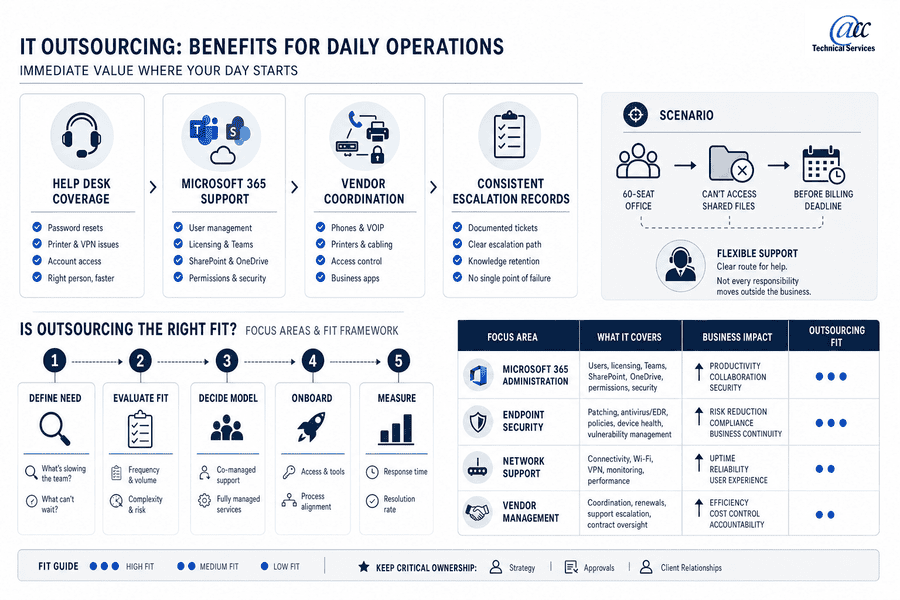
Outsourced IT value shows up first in the workday: a new employee gets into Microsoft 365, a ticket reaches the right person, a laptop stays patched, and a remote user can open the file they need before a client call. North America IT services outsourcing held over 32% revenue share in 2024, tied to cost reduction and operational efficiency, but the daily value comes from support that fits how staff actually works.
- Help desk coverage: Password, printer, VPN, and account access requests follow a defined path instead of sitting in one manager’s inbox.
- Microsoft 365 support: User management, licensing, Teams, SharePoint, OneDrive, permissions, and security settings are handled as connected workflows.
- Vendor coordination: Phones, printers, cabling, VOIP, access control, and business apps get managed around productivity when one issue crosses several providers.
- Consistent escalation records: Documentation keeps repeat fixes from depending on one person’s memory.
Specific Domain Scenario: A 60-seat office can’t access shared files before a billing deadline while the operations lead is chasing vendor calls and approvals. Flexible support gives staff a clear route for help without pretending every responsibility moves outside the business.
Those daily pain points become decision criteria when you compare support models. Microsoft 365 administration, endpoint security, network support, vendor management.
Advantages Of Outsourcing IT Services When Your Internal Team Is Stretched
The person who knows the firewall, copier vendor, SQL app, and Microsoft 365 licenses is often the same person pulled into approvals, scheduling, deadlines, or reporting. The advantages of outsourcing IT services come from adding capacity and structure, not replacing business judgment. That aligns with why 65% of organizations outsource to keep internal teams focused on core business, while 53% use external partners to solve capability gaps.
- Less dependency on one person Coverage, documentation, and escalation paths keep support moving when that key person is unavailable.
- Clearer ticket ownership Requests get routed to the right resource instead of sitting in email threads.
- Broader technical depth available Microsoft 365, Azure, networks, cybersecurity, SQL databases, and business applications all need different skills.
- Better vendor follow-through Phone systems, printers, cabling, internet providers, access control, cameras, and app vendors need coordination, not finger-pointing.
- Room for internal priorities Leaders can focus on approvals, process improvement, compliance prep, and customer service while we align support to real operational needs.
Benefits Of Outsourcing IT Services Across Security And Compliance Readiness
Audit requests, cyber insurance questionnaires, suspicious login alerts, EDR notices, account disablement, device patching, and access reviews all compete with daily work. The benefits of outsourcing IT services show up when security becomes a repeatable operating habit, not a cleanup project before renewal season.
- Access control discipline: Joiner, mover, leaver workflows, MFA, role-based access, and Microsoft 365 permissions reduce unnecessary exposure when roles change.
- Endpoint alert response: EDR and MDR activity needs triage, escalation, and documentation so alerts don’t disappear into inbox noise.
- Risk review structure: Vulnerability management, risk assessments, penetration testing, and standards such as CIS v8.1 and NIST CSF 2.0 create a cleaner path for remediation.
- Audit support habits: Evidence, policies, security settings, vendor details, and review cycles are easier to provide when maintained throughout the year.
Third-party risk still needs management, especially when 73% of leaders experienced at least one major disruption caused by a third party in recent years. We treat security support as part of business continuity: protecting scheduling, billing, production, client records, and staff access without claiming any tool or provider eliminates risk.
More On IT Outsourcing Decisions
- The Benefits Of Managed IT Services For Steadier, Safer Operations
- Why Managed Services Matters When IT Costs, Tickets, and Risk Keep Climbing
- Choosing a Managed Services Provider: Your Guide to Business Resilience
- Types Of Managed Services: What To Compare Before Choosing an MSP
- Managed IT Services Pricing: What Your Monthly IT Budget Should Actually Cover
IT Outsourcing Pros And Cons For Budget Planning And Accountability
Leadership needs predictable support, clear scope, escalation rules, and visibility into what stays internal. Cost reduction remains a major driver in software development outsourcing at 63%, but IT outsourcing pros and cons are really about fit and accountability: who handles the ticket, who approves the change, who owns the vendor call, and how the decision affects staff the next morning.
| Decision area | Business upside | Watchpoint to manage |
|---|---|---|
| Help desk and user support | Staff get a defined path for access, device, and application tickets. | Approval rules still need named internal owners. |
| Microsoft 365 and Azure administration | Licensing, permissions, cloud resources, and security settings stay organized. | Changes need review before they affect users or costs. |
| Cybersecurity monitoring and response | Alerts, patching, MFA, and documentation get regular attention. | Third-party risk matters, as 73% of leaders reported a major disruption caused by a third party. |
| Vendor and infrastructure coordination | Internet, VOIP, cabling, printers, and access systems have one support lane. | Vendor contracts and renewal authority must stay clear. |
| Custom development and SQL database support | Business apps can be maintained around workflows and reporting. | Scope control protects budgets and timelines. |
The decision isn’t all or nothing. We support co-managed support, managed services, time and materials IT services, staff augmentation, and project-based help based on the work that needs coverage. That flexibility matters when needs span Microsoft 365, Azure, cybersecurity, Power Tools and Dataverse, AI and Machine Learning, SQL databases, and everyday help desk requests.
Keep Daily IT Work Moving
Outsourcing IT can reduce delays, but the right fit matters. ACC Technical Services helps align support with your workflows.
IT Outsourcing Advantages And Disadvantages Before You Change Providers
Switching or adding IT support affects users, vendors, permissions, security tools, finance approvals, and leadership expectations. The global managed services market reached 401 billion dollars in 2025 and is projected to hit 847 billion dollars by 2033, a 9.9% yearly growth rate, but market growth doesn’t replace careful discovery. IT touches almost every workflow, so planning the handoff matters before you weigh IT outsourcing advantages and disadvantages in a real operating environment.
- Map Microsoft 365: Inventory users, licenses, shared mailboxes, groups, Teams, SharePoint sites, and admin roles.
- Surface recurring pain: List help desk issues, aging equipment, network trouble, remote access gaps, and vendor dependencies.
- Review security tools: Document EDR, MDR, MFA, backup, patching, alert handling, and who responds after hours.
- Name critical systems: Include SQL databases, accounting platforms, case management, EMR or scheduling, ERP, and production applications.
- Define approval paths: Clarify who approves access, purchases, escalations, emergency changes, and after-hours support.
This groundwork helps us recommend the right mix of managed services, security services, Azure support, project work, or staff augmentation. It also keeps the conversation grounded in the work that needs to happen, whether that involves remote support, onsite coordination in Syracuse or Central New York, local vendors, or a business application no one can afford to have offline.
Choosing An IT Partner That Fits The Way Your Work Gets Done
Outsourcing works best when it helps tickets get resolved, invoices move, remote access stays reliable, audit requests get answered, and staff approvals keep moving. ACC Technical Services is headquartered in Syracuse, NY, and we support organizations across Central New York with flexible IT services scaled to their needs. If you want to talk through Microsoft 365, Azure, help desk, cybersecurity, network support, managed services, or development needs, contact ACC Technical Services.